Whether you are a nursing student or have just entered your professional journey as a nurse, you must know how to craft a nursing reflective essay. It is one of the most common nursing assignments in which students critically evaluate their real-life clinical experience, understand their actions, and enhance the patient's care.
This essay goes beyond description of the experience, and its aim does not revolve around academics but also professional career, as this reflective essay helps in equipping the nursing professionals with emotional intelligence, competence, and adaptability. It is a significant tool that leads to professional development and growth, and allows you to be aware of your feelings, strengths, and weaknesses.
A nursing reflective essay is not a series of experiences but an academic write-up that shows insights and emotional awareness. It even connects nursing theory to practice. If you want to know about the nursing reflective essays in detail, then keep reading this blog, as it will help you.
What is a nursing reflective essay?
A nursing reflective essay is an organised writing that students and nurses craft for evaluation and analysis of their clinical experiences.
It is not the same as the general essays, as it requires the application of nursing models.
Mainly, it involves the analysis of emotions, actions, decisions, and outcomes. The aim is to identify strengths, weaknesses, and areas of improvement through this essay.
It is a personal and analytical piece of writing that answers questions such as what happened, how I felt, what I learned, and what could be improved. It transforms the experience into learning for better patient safety and quality of care. You must consider this as a chance to review your skills, personality, and career.
Why is reflective writing in nursing so important?
|
Reflection is a critical and necessary part of nursing and midwifery practice. It is essential to continuous learning and improvement of practice that benefits those we care for.source: nmc.org |
Nursing reflective essays are not merely an academic task; they also support professional development by bridging the gap between theory and practice.
-
Enhances clinical practice: writing a nursing reflective essay helps nurses to evaluate their decision-making and the entire interaction with the patient. They can identify what went well, what didn’t, and the areas of improvement. As a result, they can develop strategies that improve clinical judgment and enhance patient outcomes.
-
Promotes self-awareness: nursing reflective essays aim to make the nurse more thoughtful and insightful. Critically evaluating the clinical experiences promotes self-awareness in the nurses regarding their emotional responses, biases, strengths, weaknesses, feelings, and values. It leads to empathy and cultural competence in nursing.
-
Supports continuous learning: the field of nursing and healthcare evolves constantly. When you reflect on your experience, it leads to continuous learning from everyday experiences and adaptability to new knowledge.
-
Leads to professional growth: writing reflective essays is also required in some nursing programs and professional portfolios. These essays can reflect growth and competence.
-
Enhances emotional resilience and empathy: when students reflect on their clinical experience and patient interaction, they develop empathy and are more aligned with the patient's emotional needs. Also, nursing can be quite emotionally challenging; nursing reflective essays are also one way for nurses to channel their feelings and reduce burnout.
What are the key models that are used to craft nursing reflective essays?
There are models that you can use to structure your essay with depth in your analysis. Also, these models simplify the reflection process.
1. Gibbs’ reflective cycle:
This model was introduced in 1988 by Graham Gibbs. This model is a cyclic process that helps nurses to reflect on their clinical real-life experiences so they can identify what went well and what didn't. It is crucial for improving patient outcomes in the future. It involves stages: description, feelings, evaluation, analysis, conclusion, and action plan.
-
Description: What happened? When and where did it happen? Who was present? What did you and the other people do? What was the result of the situation? Why were you there? What did you want to happen?
It involves the description of the event. (Avoid any judgment and conclusion)
-
Feelings: What were you feeling during the situation? What were you feeling before and after the situation? What do you think other people were feeling about the situation? What do you think other people feel about the situation now? What were you thinking during the situation? What do you think about the situation now? (don't start with the analysis yet)
-
Evaluation: What worked well? What did not go according to plan? What were the challenges and failures in your leadership? Was the overall event positive or negative, and why do you think that way? Did your actions result in success or failure?
-
Analysis: In this section, you have to analyse whether different people’s experiences are similar or different. Why did the situation unfold in this way? What caused positive and negative outcomes? Is there any model or theory that can relate to the event? How did your actions influence the outcome? How different actions would have changed the outcome?
-
Conclusion: Now you have to conclude your analysis and experience. What have you learned from this experience? What should be continued based on this experience, and what should be changed? How could you tackle the situation differently and effectively? What are the areas for personal growth, and what skills will help in the future?
-
Action plan: In this section, you transform your reflection into action by explaining how you will approach the situation differently. What steps will you take if a similar situation occurs again? What skills do you need to develop? What strategies will help improve future outcomes? How will you prevent negative outcomes in the future for the same situations?
2. Dewey's reflective thinking model:
According to John Dewey, reflective practices help individuals actively and carefully evaluate a belief or supposed form of knowledge on the grounds that support that knowledge and further conclusions to which the knowledge leads. It involves learners identifying what they know and what they need to know to bridge the knowledge gap and improve the clinical outcomes. The major steps of this model include:
-
Identifying and describing the problem.
-
Analysing and investigating the issue in depth.
-
Determining the criteria to address the issues.
-
Coming up and brainstorming possible solutions.
-
Select the best solution or the combination of solutions.
-
Test and implement the solution.
3. Kolb's reflective model:
It is a 4-step process that involves transforming clinical experience into knowledge.
-
Concrete experience: a new and concrete experience or situation, i.e., performing a procedure for the first time or a patient interaction, etc.
-
Reflective observation: it involves reflecting on the new experience, given your knowledge or existing knowledge. What happened, how you felt, and identifying what worked or didn't work.
-
Abstract conceptualisation: it involves developing a new idea, sharing what you learned, and drawing conclusions regarding how everything works and is organised.
-
Active Experimentation: applying what you have learned to future situations. Experimenting with the applicability of the new knowledge.
4. Driscoll reflective model:
This model involves three questions: what? So what? Now what? These three questions are connected to the different stages of experiential learning. John Driscoll developed the model in 1994, 2000, and 2007. With this model, you can analyse and learn from experiences.
1. What?
In this section, you just have to describe what has happened and provide context. Ensure that you don't add any criticism and judgment here.
What exactly happened?
What exactly did you do?
Was anyone else involved?
Was it a good experience? Or a bad experience? Or both? And why?
2. So what:
This step involves looking for insightful moments and patterns.
How did you feel during the event, encounter, or experience?
What was your reaction and why?
Why did you react that way?
Did you feel the same way about the situation then as you do now?
Did you experience conflict with your values?
Who else was involved?
What was their role, and how did they feel?
What was their reaction and why?
Do you think past cases influenced your experiences in this situation?
3. Now what?
It includes what you have learned? And how can it help you in the future?
What did you learn from reflecting on this situation/experience/incident?
Could you have prevented the negative consequences? How?
What would you do differently if the situation reoccurs in the future?
What could you have done to prepare for the situation?
Where did things go last time, and what is your focus going forward?
4. Schon’s reflective model:
This model involves how professionals can solve problems through reflection during and after experience, reflection in action(reflecting on your efforts as you make them and thinking about what to do next, and acting immediately), and reflection on action(what could have been done differently and the positive aspects of that interaction)
5. 5R framework:
This reflection model involves five steps: report, react, relate, reason, and reconstruct.
-
Description of the scenario.
-
Why do you think it happened? What worked and what didn't?How do you feel about the experience? What specific thing about the experience makes you feel how you are feeling?
-
Relate your perceptions of the situation to your professional and personal experiences. Record your perspectives and points of view on the experience.
-
Do you relate your point of view to someone else’s and how it affects the situation? How does your point of view affect how you understand the problem? Could another point of view be helpful?
-
What you learned, the knowledge you gained, and how it will affect your future practice.
Other models are: CARL Framework for Reflection, Atkins and Murphy's Model of Reflection, Boud's Reflective Model, and so on.
|
Do you have no time to craft your nursing reflective essay? Then don't worry. Connect with our highly qualified writers who can tackle all your academic queries and help you achieve high grades. Let's connect! |
What are useful nursing reflective essay writing tips?
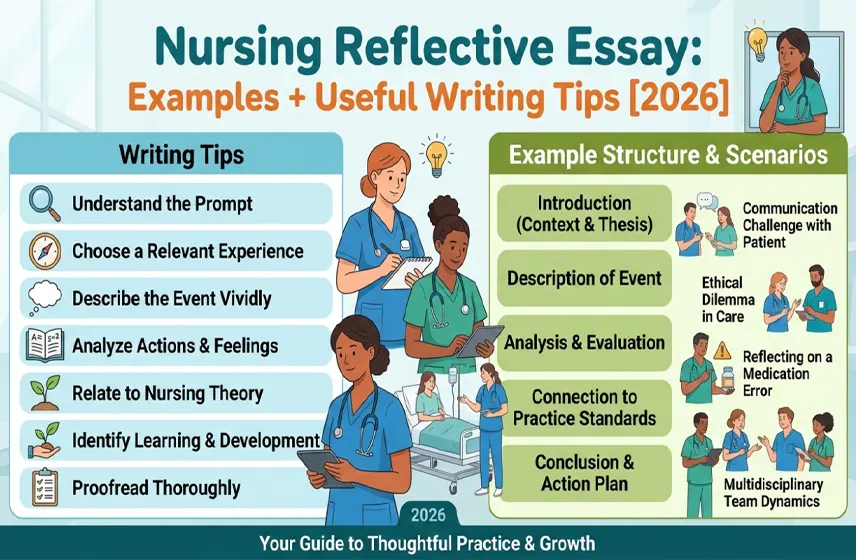
1. Focus on a specific clinical incident:
Nursing reflective essays require you to focus on a specific clinical experience and situation that had some impact on you. For example, a challenging or meaningful experience. Make sure that the names of the patient and staff are anonymised. Make sure you remember enough details about the experience so you can describe it in detail.
2. Recall and note down all the details:
Make informal notes for what happened step by step, what your and others’ roles were, what your feelings were in the experience, what went well and what didn’t, and the reason behind the scenario.
The key tip is to be honest and write about your sensory details, such as emotions and feelings.
3. Link to theory:
When reflecting upon your experience, connect it with nursing theories to make your experience credible and relevant.
4. Select a reflective framework:
Then you must select a reflective framework, as it will provide structure to your essay. You can use any one of the frameworks mentioned above. Usually, people utilise the Gibbs reflective cycle.
It includes Description, Feelings, Evaluation, Analysis, Conclusion, and Action Plan.
5. Start with an introduction:
In the introduction, set the foundation of your essay. Provide some information related to what your essay will be about, including the setting, nature of the incident, purpose of the reflection, etc. Also, make sure that your introduction makes up 10% of the total word count.
Also, it must have a hook and a thesis statement.
6. Description of the experience:
Now, provide detailed information regarding the experience. Include the what, who, when, and where parts. Write this section with clarity, objectivity, and coherence. Moreover, do not provide any judgment in this section; just include facts.
For example, during my clinical experience, I had to deal with a patient who had undergone surgery and was feeling severe pain. The patient expressed his discomfort and restlessness. I thought that following my routine tasks was the first thing I should do, and I didn't consider my patient's pain.
7. Discuss your feelings:
In this section, you must discuss your internal experience during and after the event. Include information regarding the feelings, emotions, and thoughts. Honestly, include information regarding your physical and emotional reactions, as it reflects your self-awareness. Moreover, you can also reflect on the reactions of others.
For example, after some time, I felt quite nervous as I thought I was unable to handle the situation properly. Although I continued my routine tasks. Later, I felt guilty about not considering my patient's emotional distress.
8. Evaluate the experience:
In this section, you have to assess what went well and what didn’t. Judge all the positives and negatives about the situation. You can write about the areas of improvement as well as the perspectives of others.
For example, I completed my assigned task accurately, but I did not provide holistic care, as I was unable to support the patient emotionally.
9. Analysis of the situation and your actions:
This is the most critical part of your essay; it covers the why and how part. In this section, you must connect your experience to nursing theories or professional standards.
Add the references from the textbook or articles, etc. Also, write about how you could perform differently, why things turn out as they did, etc. This section reflects your critical thinking skills and your ability to understand your experience in the broader context.
For example, this situation helped me understand that nursing is not only about physical care but also about emotional care. It made me understand that empathy and effective communication are the key components of patient care. Moreover, if I had communicated with the patient before, I could have understood his needs better.
10. Craft a conclusion:
Write about the conclusion that you are drawing from the experience. Include the lessons learned, areas of development, and the skills you need to develop.
For example, I realised that I need to develop better communication skills and empathy, considering the patient's emotional and psychological needs.
11. Create an action plan:
The field of nursing is evolving. Therefore, write your plan for future improvement and how you will tackle the same situation next time. It shows that you are utilising your reflection to become a better nurse.
For example, in my future practice, I will focus equally on the patient's emotions and provide reassurance on time. If I am not able to understand the situation, then I will seek guidance from a senior nurse so that I can deliver safe and compassionate care.
Some important tips for nursing reflective essays:
-
Analyse your actions, but balance with how you will improve them the next time.
-
Consider the patient's perspective.
-
Use many transition words in your essay.
-
Support your analysis with evidence. Make sure you add accurate references.
-
Maintain confidentiality and ethical practice.
-
Balance detail with conciseness.
All in all!
Reflecting on nursing practice provides students with the opportunity to grow and progress in their careers. When writing your nursing reflective essay, be honest, critical, and organised. Moreover, reflection is a vital tool in the field of nursing, and you must master the art of reflection if you want to move ahead.